
Countdown to 2010: Interview with Jack Sasseville by Peter Graves
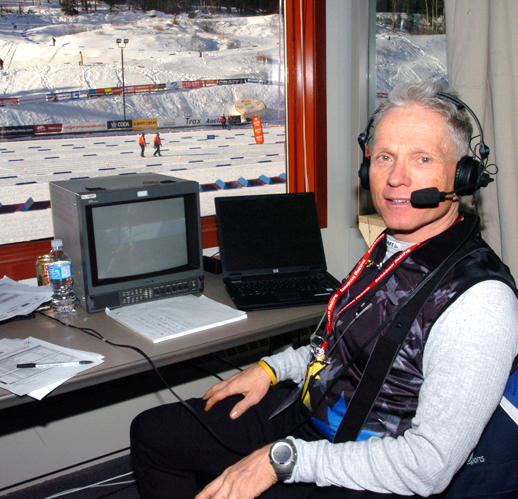
December 29, 2009. Jack Sasseville has seen cross-country skiing from many angles. As an athlete, national team coach and television commentator. He is one of those self-reliant men, who does not flinch at a challenge, and is truly passionate about the sport he loves. As you will read you’ll see that Sasseville and I go back a long way.
Back in the 1970s we crossed paths at the Telemark Resort in Cable, Wisconsin, owned by the late Tony Wise, and the birthplace of the fabled American Birkebeiner. It was also home to the first official or unofficial world cup depending on your point of view (you had to be there). Wise had printed two sets of posters for the event – World Cup and American Cup – but that’s a whole other story to be told at a later date.
I always admired Sasseville for his work ethic. His natural gifts extend well beyond sport and he has some fascinating memories. Recently, on the brink of his next Olympic assignment in Vancouver, we talked of the past, the greatness of Canadian xc ski legend Pierre Harvey, who motivated him, the Marty Hall era, and what makes a steak so tasty. Read on my friends.
We’ve known each other a long time since Telemark (WI.) days Id say?
Jack Sasseville: We first met in Telemark in the late 1970s. I think it was at the first world cup there in 1979.
You were born in Manitoba, right?
JS: I was born in Saskatoon, Sask., and moved to Manitoba in 1974 when I was 24. Winnipeg is where I really started to ski race and coach.
Tell us about your formative years there?
JS: I started to ski and teach skiing for a store called Fresh Air Experience in Saskatoon in 1973 at the start of the xc ski boom years. I was a runner who was injured during the season and also working as a fitness instructor at the local YMCA in the evening. After my fitness class there was open gym time and we normally played basketball. There were two guys who showed up for basketball who had just opened the Fresh Air Experience store. They were from Winnipeg. On a Thursday in late November it started to snow so I went to their store and bought my first pair of skis. Had a lesson from one of the two guys that night and then skied every day until the next Tuesday. That Tuesday I went back to the store and told them that I d been skiing every day and loved it. You’ve been skiing every day, they said, how would you like to be our ski instructor? The lessons start this Saturday.
So I started to teach for them that winter and at the end of the winter I took a job in Winnipeg as an assistant golf pro. One of the two guys from Fresh Air in Saskatoon had a brother who was part owner of the Fresh Air Experience store in Winnipeg so I went to see him and began to teach skiing and working in the store the next winter 1974-1975. That was Lyle Wilson you may know him now with the Nipika resort in BC – he also coached with me on the National team in the late 1980s.
I started coaching the next winter with a young junior skier. He and I both won the Manitoba Champs and during that winter I started to do coaching clinics with a local group this was the first Jackrabbit program in the country. Gord Konantz, Gary Coopland and I started this program which later became a National program in 1980. I became the Manitoba provincial coach and TD in 1977, went to the National team in 1979 and stayed there until 1992.
Who were your early mentors and skiing heros?
JS: My early mentors were Gord Konantz, a local business man who helped me to start the Jackrabbit program and organize skiing in Manitoba, Heinz Niederhauser who taught me how to coach and to ski in the late 1970s, and Anders Lenes who was the first person to teach me how to ski properly
Tell us about your racing career?
JS: I raced in Manitoba in the 1970s and was provincial champion a couple of times. I also raced in the early 1980s nationally (best finish was 8th at Canadian XC champs in the 50km in 1982). I did the American Ski Chase a couple of times, and also skied as a Master at the World Masters Championships in Telemark in 1983 and Lake Placid in 1986 where I won two silver medals. I have skied the Birkie six times with a best finish of 25th in 1986. This past winter I returned to Masters racing for the first time since 1994 and I won gold in the 30km skate race and the Canadian Nationals in North Bay.
Back in 1970 I raced in Inuvik at the Nordic World Championships. It was the first time I met people like Bjorger [Pettersen], the Firth sisters, the Allen’s [Roger would later ski at CU], Jarl [Omholt-Jensen] so many people I have long remembered and admired.
What do you recall of that time?
JS: They were all a little before my time. Most of them were at the end of their careers in 1977 at my first National team camp in Sunshine, BC. It was Burt Bullock s last camp, and Ernie Lennie as well. Sharon and Shirley [Firth] were still skiing as they did not retire until 1985. I also remember Malcolm Hunter skiing then as well. I worked for Malcolm in the late 1980s when he was CEO of Cross Country Canada.
Of course you witnessed the period of the great Pierre Harvey – tell us about him?
JS: Pierre was the best endurance athlete that I have ever seen. He had the best engine that we ever tested, but that was not the only reason why he was successful. He was a fierce competitor who really knew how to push himself in a race. He was a pussycat before and after racing, but during the race he was like a lion that had been let out of a cage it was remarkable to see the transformation.
Do you have much contact with many of the great people from that era such as Yves [Bilodeau], Laurent [Roux], Pierre [Harvey], Pierre [Vezina], Marie-Andree [Masson], or Angela [Foster-Schmidt]?
JS: Not very much. I see Yves whenever I travel to races, I did see Marie-Andree and Pierre Vezina at Mont Ste-Anne a couple of years ago when we had Nationals there. Angela lives near here, but she has separated from husband Don and has dropped out of sight. Lorna [Sasseville nee Daudrich] and I divorced 15 years ago and she is still in Canmore, AB. Carol Gibson and Jean McAllister live there as well.
About what time did you break into the National Team staff?
JS: I started in 1979 and was there until 1992.
What was your first job on the National Team and who was the coach?
JS: I was the women’s team coach for 1979-80 and then became head coach in 1980-81 until Marty Hall came on board in 82 and I was assistant coach.
Tell us about that time when former US Ski Team coach, Marty Hall was at the helm?
JS: We had a great team of coaches with Marty and Laurent and myself from 1984 to 1992. I think we raised the level of skiing in Canada during that time higher than it had even been until the last few of years. I only wish that WADA and its doping controls would have been as strong then as it is now. I think that Pierre [Harvey] could have won Olympic medals and our team could have been as strong out there as it is these days.
There was great team progress during Marty’s time there. He was a great leader with a great vision, and he was able to persuade people to follow that vision. That was his real strength. He was a bull and would power forward to get what he thought was right.
What do you think people didn’t understand about Hall?
JS: How committed he was, as an American, to push Canadian skiers and the Canadian program forward. When Marty was working for Canada, he was working for Canada and he wanted to beat the US Ski Team most of all.
His comments about doping caused quite a stir at the 1988 Calgary Games didn’t they?
JS: In the end he was probably right on about it all. He was absolutely correct about the doping. As I said, it’s too bad we [Canada] could have been so much better if the playing field had been level.
What was the greatest highpoint you experienced in skiing?
JS: I had two great days with the team – #1 when Marie-Josee Pepin won a silver medal at the 1989 Junior Nordic World Championships in Hamar, Norway. She and I had worked together for four years for that moment. She was second to Italy s Stefania Belmondo. #2 in 1992 our women s team, on the last possible date, they skied the race of their lives to qualify for the 1992 Olympics in Albertville, France. Lucy Steele, Rhonda Delong, Jane Vincent and Lorna Sasseville skied above the qualifying standard after 15 months of trying and failing.
What was the hardest moment?
JS: XC skiing is the kind of sport where it seems you fail much more than you succeed. There were a number of dark moments, but likely the worst was failing in Calgary at the 1988 Olympics. While we had some of our best ever results, it was still a long way from medals and it seems that s all that the media and fans understand.
You started commentating on TV at the Nordic Worlds in Thunder Bay correct? What was it like to be in front of the camera for your first time?
JS: I actually started TV commentating in 1997 with CBC where I did the Nordic World Champs show from Trondheim, Norway. In Thunder Bay in 1995 I was the stadium announcer for xc skiing.
And you’ve done many more since then for CBC and this winter for the 2010 Games for CTV.
JS: I have done races every year since 1997 for CBC including the Olympics in Nagano, Salt Lake and Torino.
How has the coverage of cross-country skiing improved?
JS: It has been pretty static with CBC, but it is going to be fantastic this year from Vancouver with CTV and the consortium. Every minute of every race will be shown live (and a lot of repeat coverage as well) either on one of the 12 networks (8 English, 4 French) in Canada or on the internet. This is going to be for every sport.
Do you ever hear what kind of ratings the coverage draws in Canada?
JS: We have done well during the Olympics, but outside of the Games there are usually 70,000 to 100,000 viewers for World Cups or World Championship races that we have done.
Can you tell us about any new innovations that CTV will use for cross-country skiing at the 2010 Games?
JS: The host broadcaster for xc skiing is a Finnish group that have done many Olympics in the past, I don t know what they are planning yet, but the courses will be fully covered for cameras.
Beckie Scott will be working with you who s on the team that will put xc ski coverage together?
JS: Beckie and I will do colour with RJ Broadhead, a Rogers Sports commentator, doing play by play. It will be the first Olympics for both of them, but we have had some training days already and everything looks and sounds great. It will be new for me to have three people in the booth, so I m going to have to learn to shut up and take a break sometimes.
When you are voicing a show, what do you think are the most important things you try and point out?
JS: The role of the color analyst is to tell the viewer why and how. Play-by play tells the what, who, when and where. My role is to tell the story and let the viewer know what the skiers are likely thinking, their strategy, the behind the scenes stuff, the waxing, the weather and its effect why is this happening, how did it happen, what should happen next and any personal insight that we have into the skiers and the sport.
Our main role is to entertain, and understand our audience. 95% + of the viewers are new to the sport so we must educate them on what is going on. Most people see xc skiing as boring and dull. We have to make it come alive and be exciting. To do this we have to be excited about the sport and the racing and transmit this excitement to the viewers.
Gotta ask…do people ever ask you for autographs?
JS: Not with a straight face!
There s no doubt the Canadian team is stronger than ever…what are you hoping for in Whistler?
JS: I believe that the Canadian team has a good chance for two medals the women’s sprint relay and a distance medal from either Devon, Alex or Ivan in one of the three distance races. A great Olympics will be three medals, and the moon, stars and sun will have to align for them to win four.
The Scandinavians will of course come in strong but there are more nations doing the world cup now than ever before?
JS: It seems that there are one or two good skiers from at least 10 nations all of whom could win a medal. The sport has changed so much in the last five years. Sprint racing has leveled the field for the other nations and the mass start races have changed who can win. I don t think that Norwegian great Bjorn Daehlie would be as successful now as he was he did not have a kick at the end. At individual start races in the past he didn t need it he was minutes ahead by the end. Now the prototype is skiers like Norway s Petter Northug he skis like he s in a bike race staying with the leaders and then out-sprinting them at the end.
Tell us your thoughts about the Russian doping scandals making headlines this year?
JS: I believe that the difference for the Russians now is that the doping is not state-controlled, but done by the coaches and the skiers. In the past when it was state-controlled they never got caught because the state administered the drugs and made sure that they passed the tests. Now it s being done by coaches and skiers and they re not as good at it. The more they catch any dopers the better for me. It s easier for me to sell the sport to kids when I can tell them that the playing field is level and that if they try hard they can succeed. I really couldn’t say that in the 1980s.
Is it ever hard to do reporting when you re so close to the team?
JS: I am far enough away from the team now that it s not an issue for me. I try to be balanced in my comments and if someone is not doing well I will say it even if they re Canadian. We have been preached to for years at CBC that we are not part of the team – we are reporters telling a story. We were never allowed to be homers or say we .
How is it going at your current job as president and GM of Hardwood Hills?
JS: It s now called Hardwood Ski and Bike. We re-launched the business right at the start of the recession, so it’s been a struggle. We have great support from our investors, staff and customers, but cash flow is always an issue. Having said that we can see the light at the end of the tunnel. People are starting to spend more and I am looking forward to a great winter this season. We have upgraded everything here and now have the best grooming on great trails – and we do it every day. In the summer we have mountain biking, trail running, RC Car races, cyclocross racing pretty well anything that you can do on dirt.
You re also a terrific golfer – are you still playing and how’s your game?
JS: The last two summers I have not had much time to play, but I m still a golf professional and have taught a couple of days a week at a country club in Collingwood. Before I bought Hardwood I was the Director of Golf at a private club just north of Toronto for six years. My game is still very good I love to hit balls and practice.
Do you see similarities in golf and skiing, especially the mental side?
JS: I think that golf is much harder on the mental side than skiing. Mostly because of the fear of failure that can be there on every shot. As hard as skiing is physically that s how hard golf is mentally. Every shot begins in the mind and is controlled by the mind. And you keep score every time you go out.
What’s a perfect day for you completely away from skiing?
JS: I love to ride my bike and play golf. So a ride in the morning followed by a 2-hour practice session and then 9 holes of golf is perfect for me in the summer. In the winter I still love to ski every day but a perfect day would be to ski without my walkie-talkie.
What is your current state of mind?
JS: Great. I have found a new sport in cyclocross and have done a few races this fall. I try to train every day and have never been as healthy. I thought once that I could retire at 55 but now I am not so sure that I will ever retire. I m 58 and feel great. I am looking forward to another great ski season and going to Vancouver.
What s your favorite book and movie?
JS: My favorite movie is Apocalypse Now with Blade Runner a close second. I guess I like dark movies. I read constantly and have read a number of books lately that have been very good the best I ve read lately is The Gargoyle by Andrew Davidson.
Do you have a motto you live by?
JS: There are three ways to do things in life too much, too little and just right. I always try to find out what is just right for me.
What is the one attribute you value most from your friends?
JS: Respect and loyalty.
What’s one thing really pisses you off?
JS: Computers that don t work.
Favourite place to eat in the world and why?
JS: I love a good steak, so any good steakhouse that can do a striploin well.
You have stayed in hotels the world over. Which one was the absolute best?
JS: The Movenpick in Zurich great restaurants and first time I ever had octopus and shark.
Have you ever had a nickname that you can share with us?
JS: I’ve had a few but none that have stuck.
All the best this season and with CTV at the 2010 Olympics.
JS: Thanks, Peter. Some fun questions.