
The Biathlon Rifle
Biathlon – the sport that fascinates millions. And it is a sport in which a large and impulsive effort is necessary for cross country skiing whereas shooting needs exact control and stability of the body to hit the aims at a distance of 50 metres with a small bore biathlon rifle. To be quick this is what counts, be it in cross country skiing or in the shooting range. It is often there that the results achieved decide on victory or defeat. It is therefore of utmost importance that a shooter can completely rely on his or her biathlon rifle in any weather conditions. After 1978 the rules required a small bore rifle with rim cartridge primer in calibre .22 l.r. (5.6 mm) for biathlon shooting. This calibre, next to air rifle shooting, is used exclusively for the Olympic Summer Games for rifles disciplines.
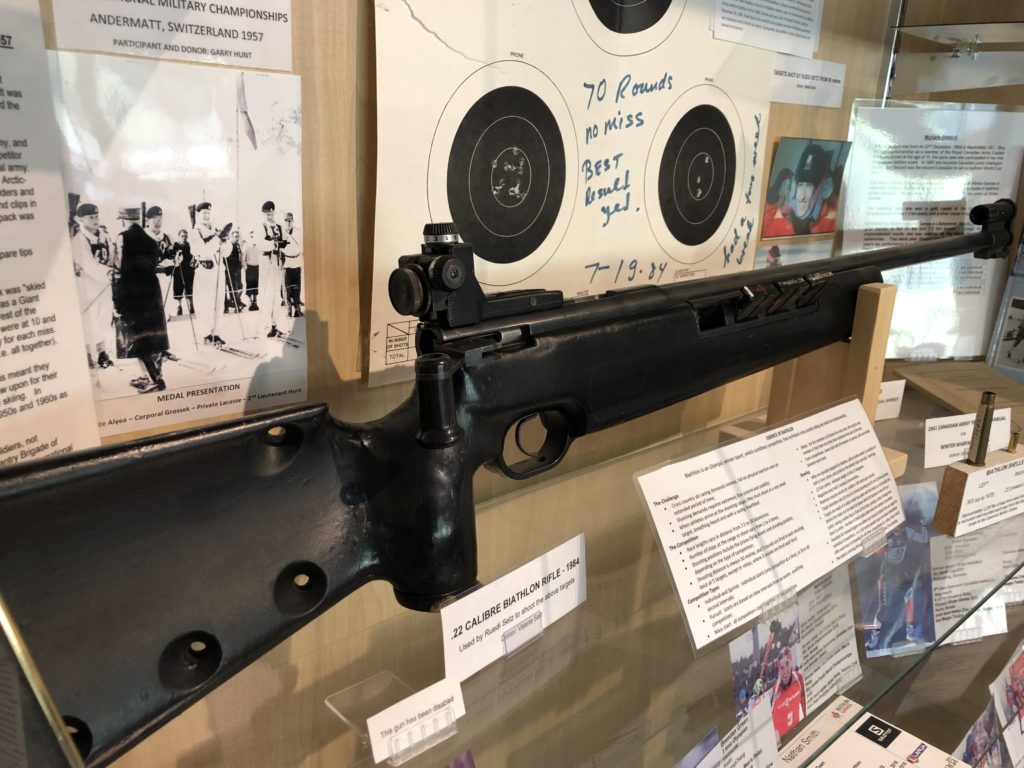
These small bore rifles are relatively heavy, up to 7.5 kilogrammes and have a cylinder action with lateral bolt handle which is lifted and pulled back for loading to feed the cartridge in by hand. Subsequently the action is pulled forward and locked by the lateral bolt handle which is turned downwards. When the biathletes turned to small bore rifles the cylinder action of J. G. ANSCHUTZ GmbH & Co. KG was equipped with a repeater device and a five shot magazine and the weight of the rifle was reduced to 4.5 kg. With the extremely light firing pin with only 4 mm travel this rifle got an extremely short locktime of 4 metres per second (i.e. that the bullet left the barrel at 4 m/s after the shot had been released by the trigger). It is of utmost importance for the shooter that the bullet leaves the barrel as fast as possible after shot release to reduce aiming mistakes.
The complete rifle slightly moves during the aiming process because it is not possible to permanently keep the rifle motionless. To be quick – that is what counts. Thus the engineers also tried to reduce the time needed for the repeating process when they continued the development of the biathlon rifle. In Finland, a rifle with lateral toggle action was developed, the Finn-Biathlon. This action had the disadvantage that a lateral cocking lever was far away from the centre axis of the rifle. Also, the cocking travel of the cocking lever was very long so that the cocking hand had to leave the pistol grip for cocking. This impaired the stability of the shooter and rifle considerably, especially in the standing position. Although the loading process could be slightly accelerated compared to the cylinder action, this rifle only survived for a short time and has now completely disappeared from biathlon use.
The Russians developed a small bore biathlon rifle which had several improvements over the Finn-Biathlon and is still in use. However, with this rifle as with the Finn-Biathlon, the shooter risks leaving the centre of aiming while repeating due to the lateral cocking mechanism. In addition, the heavy striker piece of this system extends the locktime considerably compared to the ANSCHUTZ-Fortner biathlon rifle. To reduce the disadvantages of a lateral toggle action, the former German Democratic Republic (GDR) and the Federal Republic of Germany developed a “pistol grip repeater”, where repeating was carried out by tilting the pistol grip axially to the barrel axis.
With this system, the rifle did not leave the centre axis by loading, but there was the danger that the tilting of the pistol grip would result in transferred motion on the butt plate and thus on the shoulder of the shooter, which made aiming difficult after repeating. Only a few of these pistol grip repeaters were manufactured before they, too, vanished from the market. All these developments with the disadvantages described above were finally followed by the ANSCHUTZ Fortner biathlon rifle.
The patented Fortner straight pull action operates very smoothly and can be opened quickly with the index finger and closed with the thumb. The axial action facilitates aiming after repeating because the loading process is carried out by the wrist and it is not necessary to move the hand from the pistol grip, allowing the rifle to remain very stable in that position. The elbow does not move, which is a great advantage especially in prone position. In addition, the extremely short locktime of the Fortner action of 3.5 to 4 metres per second combined with the possibility of extremely short repeating is unsurpassed. A further major point is the shooting accuracy of the ANSCHUTZ cold tested precision barrels manufactured according to a special procedure. These barrels are available in normal version (total weight of the rifle approximately 4 kg) and in a sprint version which is 200 gm lighter.
More than 97% of the biathletes who take part in international competitions use the ANSCHUTZ Fortner biathlon rifle.
Source: International Biathlon Union