

| Men |
| Merritt Putnam |
| William Thompson |
With three athletes and two support personnel selected two months prior to competition, Canada entered the Olympic cross country fray in 1928. After missing a week of training while at sea on route to Europe, skiers William Thompson of McGill University and Merritt Putnam of Toronto concentrated on the cross country sprint and nordic combined events. With the trails made known to the athletes only the night before the events, no Canadians competed in the 50 kilometre endurance test won by Sweden’s Per-Eric Hedlund in 4:52:03, still the slowest time ever for the event.
Numerous falls troubled Thompson and Putnam on the icy 18 kilometre course as they settled for 37th and 40th spot among 44 finishers in 2:12:24 and 2:22:40 respectively. Norwegian Hohan Grottumsbraaten took gold in 1:37:01, reflecting the lack of major trail preparations other than marking them in the ‘good old days’. Putnam concluded his Olympic thoughts with, “Although outclassed, Canada was by no means disgraced. Given a few more years, we will surely give our Norwegian friends a great run for premier honours.”
The longer newspaper article shown below, dated 31st December, 1927 reports a change in departure date for the 1928 Canadian Olympic Ski Team, in order to give them more training time at St. Moritz, Switzerland, the venue for the 1928 Games. Instead of sailing on January 22nd, the team was now scheduled to leave from Halifax on January 8th.
The shorter article announces the nomination one additional member of the team, O. Tellefsen, from Hollyburn Pacific Ski Club of Vancouver. However, a report on the 1928 team in the Canadian Ski Museum archives does not list Tellefsen as a member of the eventual team so it is possible he did not make the trip.
The team members as listed in the official records were: Leonard Lehan (Montreal Ski Club), William B. Thompson, (McGill University Ski Club), Merritt Putnam (Toronto Ski Club) and Gerald Dupuis (Cliffside Ski Club).
It was a joint decision of the Canadian Amateur Ski Association (CASA) and the Canadian Olympic Games Committee which allowed Canadian skiers to participate, for the first time, in the Olympic Winter Games of 1928. Of the several winter sports represented, the spectacular ski jumping and the challenging downhill sections of the cross country races were among the main attractions.
Arriving late, the Canadian team was at an immediate disadvantage. It was cautioned not to begin training immediately due to the “…peculiar knock-out effect of the high altitude” (H.P. Douglas, Canadian Ski Annual 1927-1928). Many of the other teams had been training in Switzerland for a month and were already well acclimatized.
Thompson and Putnam competed in the 18 km cross country ski running event while Dupuis competed in both ski jumping and nordic combined events. Lehan unfortunately suffered a knee injury while training and was unable to compete in the ski jumping competition.
The Canadians were unaware of nuances in the technique of the Europeans, who were able to reduce their speed on the steeper downhill sections using their ski poles as brakes, by dragging the poles behind them in the snow. Nevertheless, the Canadian skiers finished with strong performances. H.P. Douglas, then president of the CASA, reflecting on the Canadian performance, noted that the team was outmatched in skill levels but was not disgraced. Canada was well represented and the team performed effectively.
The 1928 Olympic Winter Games took place from February 11th to 19th.

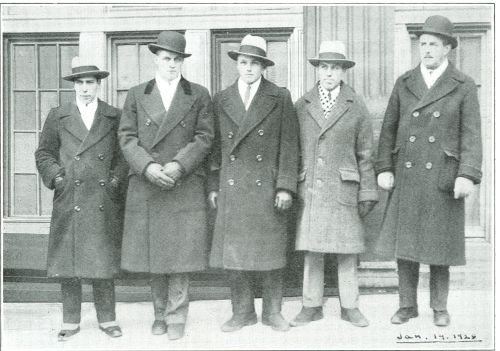
Left to right: Gerald Dupuis, Leonard Lehan, W. B. Thompson, Merritt Putnam and H. P. Douglas (team manager)
Source: Canadian Ski Museum archives
MY EXPERIENCES AT THE 1928 OLYMPIC GAMES
By M. G. PUTMAN (From the Canadian Ski Association Yearbook)