
Eino Tikkanen, who lived in Beaver Lake, Ontario, excelled as a cross-country skier, was also keenly interested in the development of ski waxes. In the 1920s and 1930s, northern Ontario skiers relied mainly on ski waxes which were imported from Finland or Norway, but many developed their own waxes. Perhaps the most scientific of these was Eino Tikkanen, who carried out meticulous experiments for a period of nine years. He developed a number of good waxes which were used by skiers from Beaver Lake, Sudbury and other northern communities. He sent samples of his waxes to Finland to be used or tried by skiers from his previous home community of Kiuruvesi. He was told by these skiers that he had found waxes as good as any made in Finland.
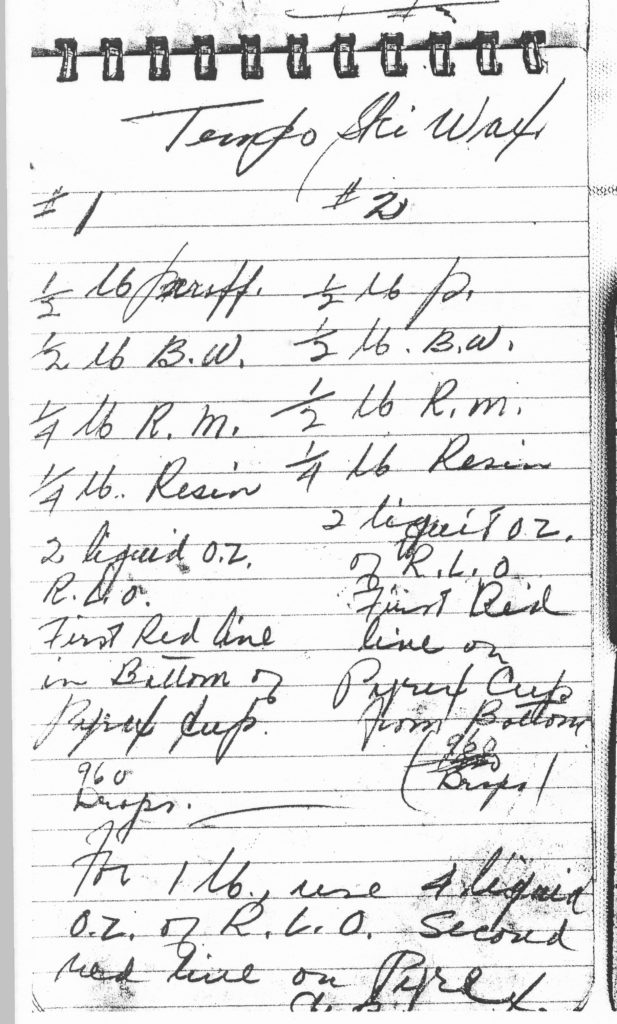
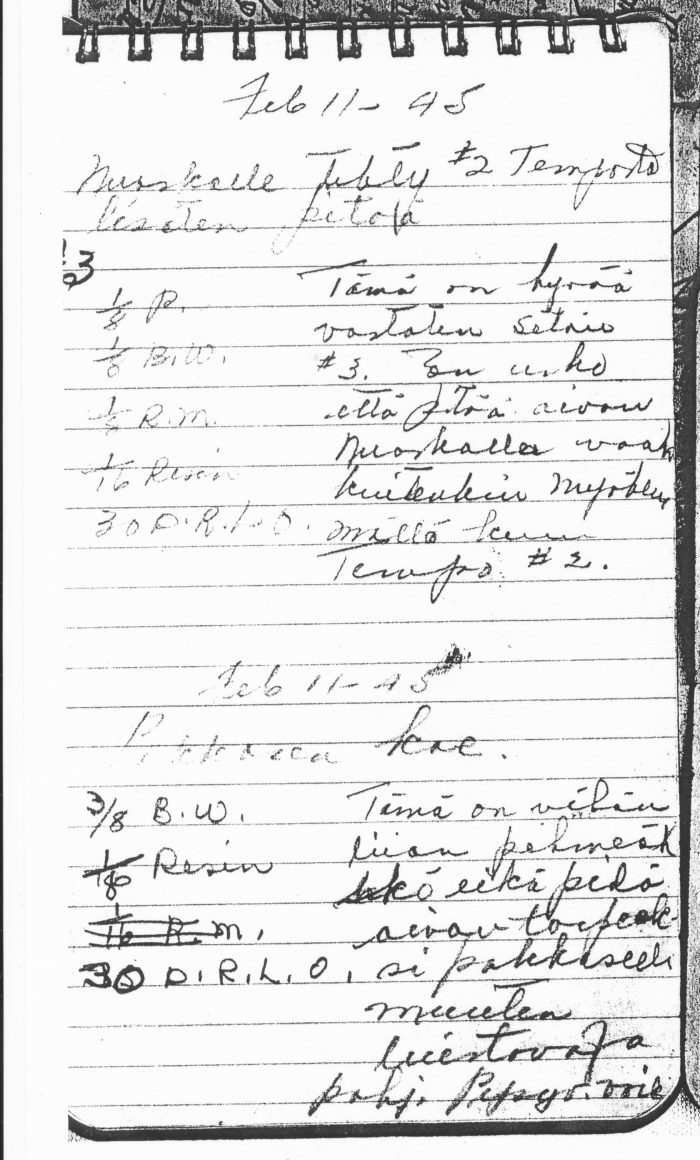
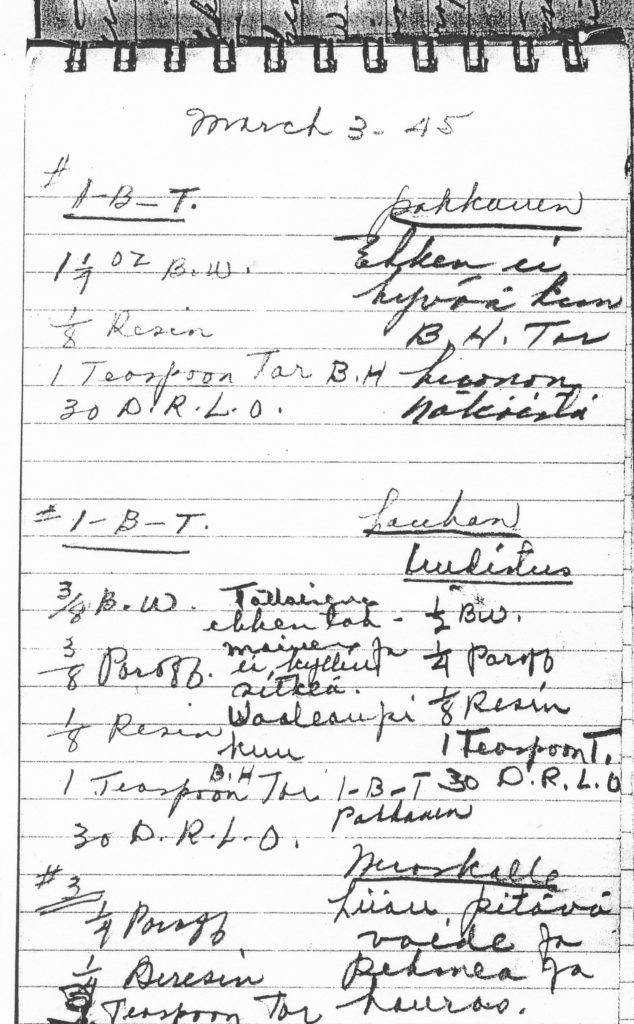
Tikkanen recorded his experiments and made a conscious effort to improve his waxes. Reading his notes of the experiments reveals the meticulous attention to detail. The ingredients he used ranged from pine tar to cod liver oil, although the latter substance was abandoned due to its low durability. Other ingredients included bees’ wax, resin, sperm whale oil, and paraffin. Proportions were carefully calculated and experimented with.
Below are copies of Tikkanen’s original handwritten formulas for some of his waxes, dated 1945.
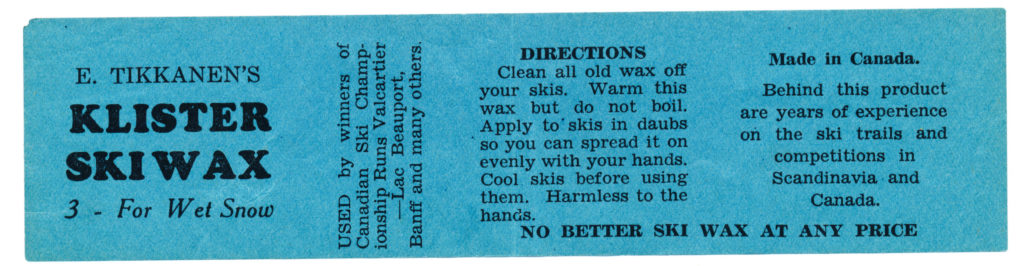
Below is a label from a tin of klister ski wax:
In Tikkanen’s opinion, ski wax had to have three different qualities – glide, grip and sustainability. Cod liver oil gave very good grip and did not hinder glide, but it was only effective for a short period of time as the oil evaporated too quickly. The best ingredient for wet snow klister was purified pitch. Ordinary household floor wax looked good, but it had no glide on cold snow. Beeswax was very good but was in short supply so its use was limited. Sperm whale oil was fragile. In his wax experiments, Tikkanen mixed small pieces of rubber with the oil, which gave some flexibility.
Used by university teams from Montreal to California, Tikkanen’s largest order was for 3,000 “cakes” of wax. He supplied wax to the Canadian ski team coach, Jack Wahlberg, as well as to the Swedish ski team.
As well as his waxing experiments, Tikkanen was an acclaimed ski racer, and he liked to recount his memories of being a competitor. One such event was a 30 kilometre relay race, when the winner crossed the line only half a ski length ahead of the second place finisher (Editor’s note: that kind of result was less common 80 or 90 years ago than it is today). Once the race was over, competitors gathered together to drink berry juice and review the race in detail. A sauna was also an essential part of the post-race rituals.
Trips to ski races at that time could be very lengthy – racers would ski together to the race venue, complete the race distance, and then ski home again after the sauna and refreshments. The journey to the venue could easily be 15 kilometres and in those days before machine grooming, skiers would be breaking trail all the way.
Training in those days was relatively unsystematic. In the fall, skiers would get together fairly frequently to do some “muokkausvoimistelu” or gymnastics as well as walking along twisty and hilly roads around Beaver Lake. Tikkanen, who skied his last race in 1943, always enjoyed racing as he felt it gave something extra to a skier, giving more of a feeling of satisfaction than one gets from purely recreational skiing.
Tikkanen had strong memories of many races where his waxing acumen helped him or others achieve good results – he developed a sort of intuition regarding weather changes and the need to adapt the wax.
Source: Karl Kinanen archives